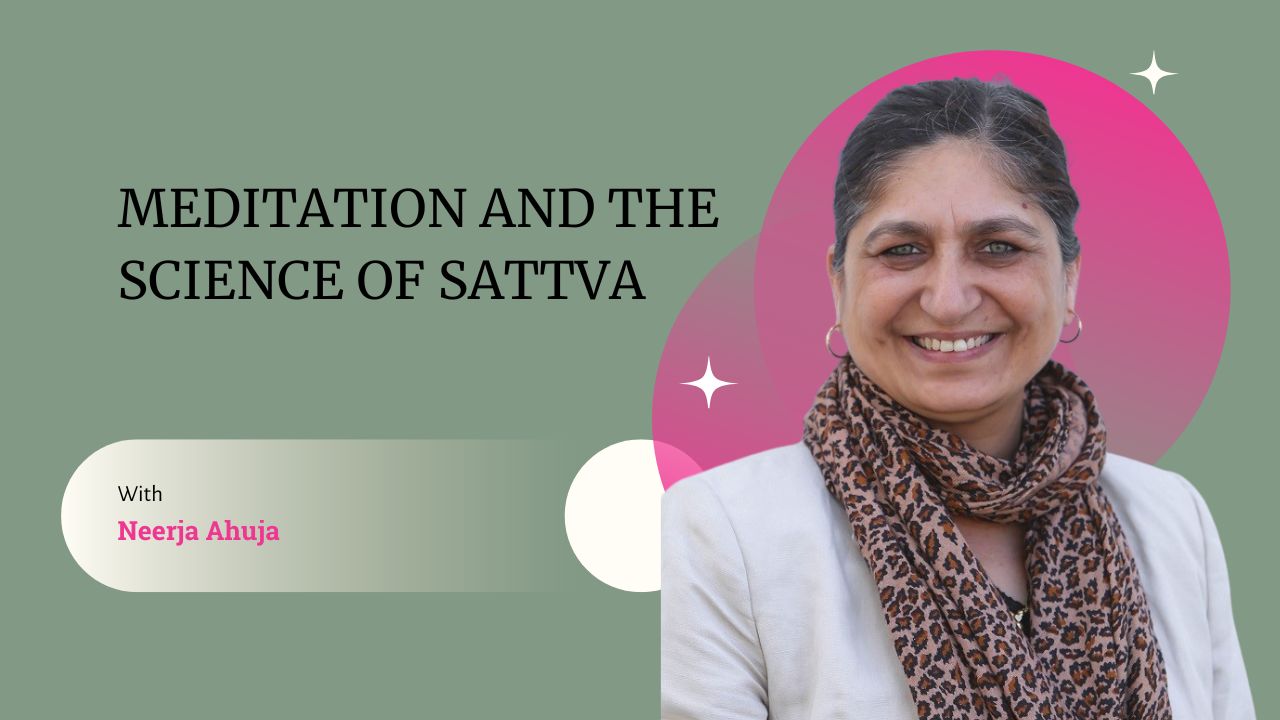
This deeper understanding comes from the Ayurvedic concept of Sattva, a state of mental harmony that forms the foundation of emotional resilience. The science of Sattva (gunas/ attributes) shows us that mental health is not an isolated function of the brain, it is influenced continuously by the body, breath, lifestyle, food, and our inner state. Ayurveda understands this relationship in an elegant and holistic way.
The Three Gunas – A Complete Framework of the Mind
Ayurveda describes the mind through three Gunas, Sattva, Rajas, and Tamas. These are the fundamental qualities that influence how we think, feel, and respond to life.
Sattva represents clarity, peace, intelligence, and equanimity. It is the state in which the mind feels light, focused, and open. When Sattva predominates, we feel grounded yet adaptable, alert yet calm, engaged yet content.
Rajas brings movement, passion, and activity. A certain amount of Rajas is essential for action, ambition, learning, and creativity. But when it becomes excessive, the mind becomes restless, overstimulated, anxious, and easily exhausted.
Tamas creates heaviness and inertia. It gives the mind the ability to slow down and rest. Yet too much Tamas leads to lethargy, resistance, apathy, procrastination, and emotional withdrawal.
Ayurveda explains that imbalance begins when Rajas and Tamas overpower Sattva. Increasing Sattva is therefore central to Ayurveda’s approach to mental wellbeing. When clarity and calmness guide the mind, emotions become more manageable, thoughts become less chaotic, and the inner world becomes easier to navigate.
Meditation – The Fastest Pathway to Sattva
Meditation is one of the most effective ways to increase Sattva. In Ayurveda, meditation is not a luxury or an escape, it is a core mental hygiene practice. Through meditation, the speed of the mind slows down, the nervous system relaxes, and the inner noise settles enough for clarity to arise.
Modern research supports what Ayurveda has taught for thousands of years. Meditation has been shown to reduce symptoms of anxiety and depression, lower cortisol levels, improve focus, and enhance emotional regulation. It strengthens the neural pathways that support resilience and helps shift the mind from fight-or-flight into a restorative state.
Whether a person meditates for five minutes or twenty, the cumulative effect is a mind that becomes more responsive and less reactive.
Pranayama – Breathing Techniques That Regulate the Nervous System
Pranayama, yogic breathing practices, provide another powerful way of cultivating Sattva. Ayurveda considers the breath to be the bridge between the mind and the body. When breath becomes erratic, shallow, or tight, the mind follows the same pattern. When breath becomes slow and rhythmic, the mind shifts into calmness.
Breathing practices such as deep diaphragmatic breathing or alternate nostril breathing, bhramari pranayama or bumble bee breath, directly influence the autonomic nervous system. Research shows that pranayama helps reduce stress, calm the heart rate, and balance the body’s physiological response to pressure. This makes pranayama a valuable tool for anyone experiencing chronic stress, anxiety, or emotional instability.
Yoga and Yoga Nidra – Movement and Deep Rest for Inner Balance
Yoga supports Sattva by integrating breath, movement, and mindful awareness. Instead of merely stretching the body, yoga stretches the mind, creating spaciousness, slowing down internal fluctuations, and helping people feel more centred.
Yoga Nidra, often described as “yogic sleep,” takes this a step further. It guides the mind into a state of deep consciousness while the body rests profoundly. A thirty-minute session of Yoga Nidra can provide rest comparable to several hours of deep sleep. For individuals experiencing mental fatigue, insomnia, or emotional overload, this practice can be transformative.
From Ayurveda perspective, Yoga Nidra replenishes Ojas, the subtle essence responsible for vitality, calmness, and emotional stability.
The Role of Food in Supporting a Sattvic Mind
Ayurveda has long recognised that the mind is influenced by food. This understanding is now echoed in the growing field of Nutritional Psychiatry, which studies how diet affects mood, cognitive function, and emotional health.
A Sattvic diet includes fresh, warm, light, and nourishing foods that support clarity and calmness. Meals that are overly heavy, processed, or stimulating tend to increase Rajas and Tamas, leading to mental fog, emotional swings, and reduced resilience.
Ayurveda also emphasises how you eat, mindfully, in a peaceful environment, and at regular times, as much as what you eat. Digestive rhythm is closely linked to emotional rhythm.
Ayurveda’s Contribution to Modern Mental Health Care
What makes Ayurveda unique is its integration of mental, emotional, and physical health into one cohesive framework. Instead of isolating symptoms, it looks at the entire person, their habits, sleep patterns, digestion, thoughts, environment, and spiritual needs.
This approach aligns well with modern integrative medicine, offering practical and clinically relevant tools that support mental well-being at the root level. Meditation, pranayama, yoga, and mindful nutrition are not abstract concepts but measurable, accessible interventions that strengthen the mind from within.
Ayurveda reminds us that clarity, peace, and emotional balance are not random states. They are qualities we can consciously cultivate. When we nurture Sattva, we create the inner conditions that allow healing, resilience, and inner stability to thrive.